MOBIUS
The newly developed MOBIUS (MOvement BIomechanics Unit for rehabilitation Science) Laboratory is dedicated to advancing research in human gait, balance and mobility. This space was designed to support rigorous biomechanical experimentation and to deepen our understanding of how individuals walk and adapt under a wide range of controlled conditions.
By integrating immersive simulation technologies, precise motion-capture instrumentation and realistic mobility challenges, MOBIUS enables investigators to study movement with a level of detail and flexibility not previously available in our facilities.
The lab supports investigations into:
- how people respond to destabilizing environments
- how they adapt to prosthetic and orthotic devices
- enables detailed studies of movement patterns across time
Lab Features
Instrumented Split Belt Treadmill System
At the center of MOBIUS is an immersive virtual reality/augmented reality split-belt treadmill system (M-Gait, Motek Medical, Houten, Utrecht) designed for highly controlled gait studies. The treadmill features two independently controlled belts with embedded force plates that measure ground reaction forces under each foot. An overhead safety harness allows participants to safely experience challenging or destabilizing conditions. The system can deliver multi-planar disturbances, including trips, slips and lateral shifts, as well as incline and decline walking.
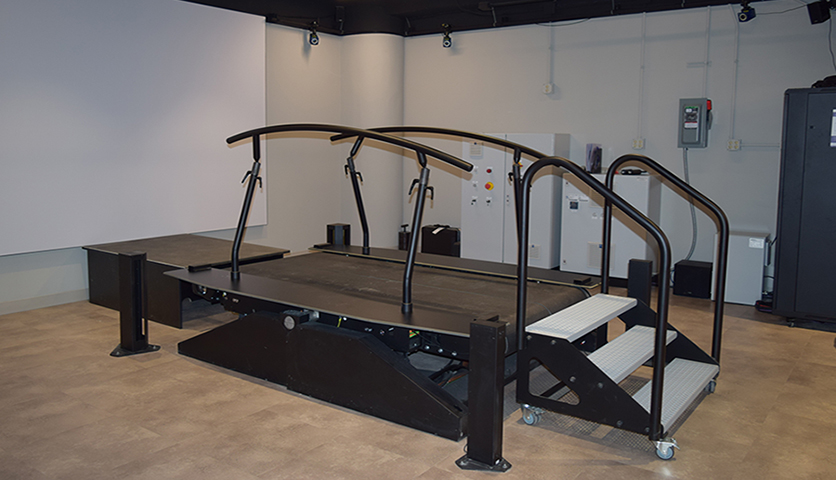
Virtual environments and interactive visual stimuli are projected onto the belts, enabling us to simulate obstacles, targets and varied walking scenarios for both training and long-duration assessments. Watch the split-belt treadmill system in action below.
Optical Motion Capture System
An array of eight high-speed optical motion analysis cameras records precise three-dimensional movement data, with reflective markers placed on the body to allow investigators to track joint angles, limb trajectories and whole-body coordination with high accuracy.
The system supports detailed kinematic analysis during treadmill walking, balance perturbation tasks and device evaluation studies. Motion capture data can be integrated with treadmill force measurements to build comprehensive biomechanical models that evaluate how individuals adapt to prosthetic and orthotic technologies.
Configurable Parcourse
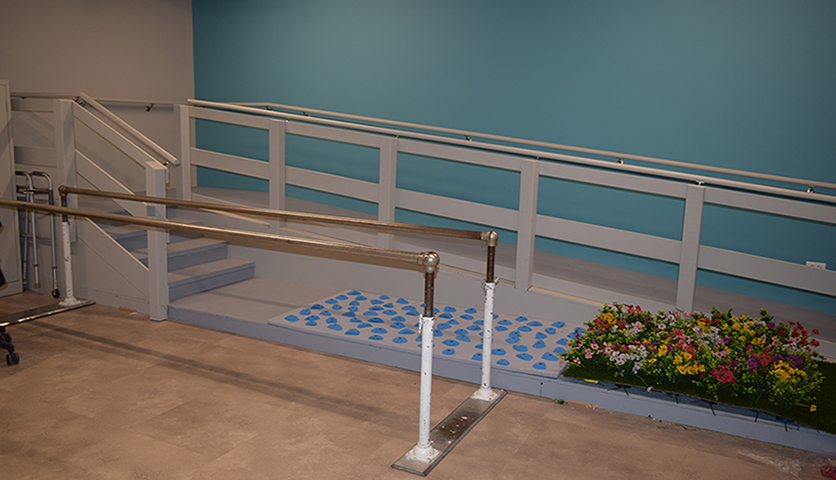
The lab also features a versatile parcourse that supports experiments that cannot be fully replicated on a treadmill. The parcourse is designed to replicate real-world mobility challenges, providing a platform to evaluate prosthetic and orthotic device performance during overground walking in natural and built-environment conditions. The parcourse features uneven (rocky) terrain, short grass, meadows, stairs and ramps, enabling us to study movement strategies during tasks requiring balance and adaptability.